In the past semester of cs 108, I learned a lot of academic phrases for game design. It was beneficial for me to express my thoughts about games in the way of formal language. I can observe and describe a game in some scholarly ways, like MDA. Additionally, this academic knowledge about game design shapes my ideas and thoughts about game design and encouraged me to designed my games. Learning these academic pieces of knowledge about game design also allows me to consider things differently from the view of game designers instead of a pure gamer.
The most precious part about the course is making video games. It made me confirmed that I love game design, and I was able to do it on my initiative. I spent more than 20 hours on reading tutorials on both projects and 20 more hours actual building time on both of them. Other than the coding part, I was able to learn animation, graphic design, sound editing, and scriptwriting in these two projects. The time that I was not able to write anything. The time that I stuck with bugs… It was some really tough process to go through and after the bitter taste, I am able to say that I have been through the process of game development.
I definitely read, write, play, and design games in this class. It was the most exciting course in all cs courses, and I will recommend this course to any gamer in CS department.
Blog Post 8: Final Project
Our final project is a puzzle horror game building with RPG maker mv. It is not named yet, and the project name is horror.
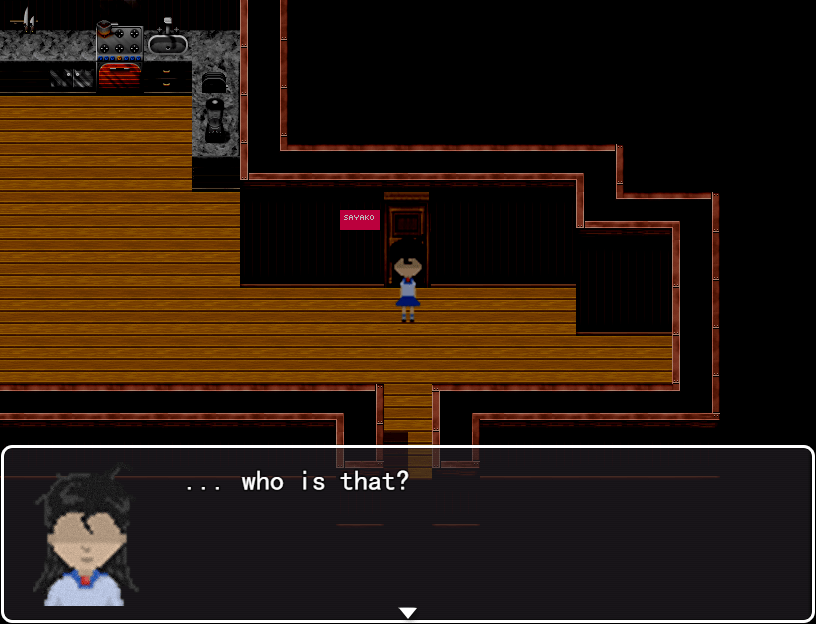
In project horror, players will be able to control the main character Sayako to explore her apartment after a mystic coma. Players need to help Sayako reveal the bloody truth that happened on her and get rid of her spooky apartment that she no longer be familiar with.
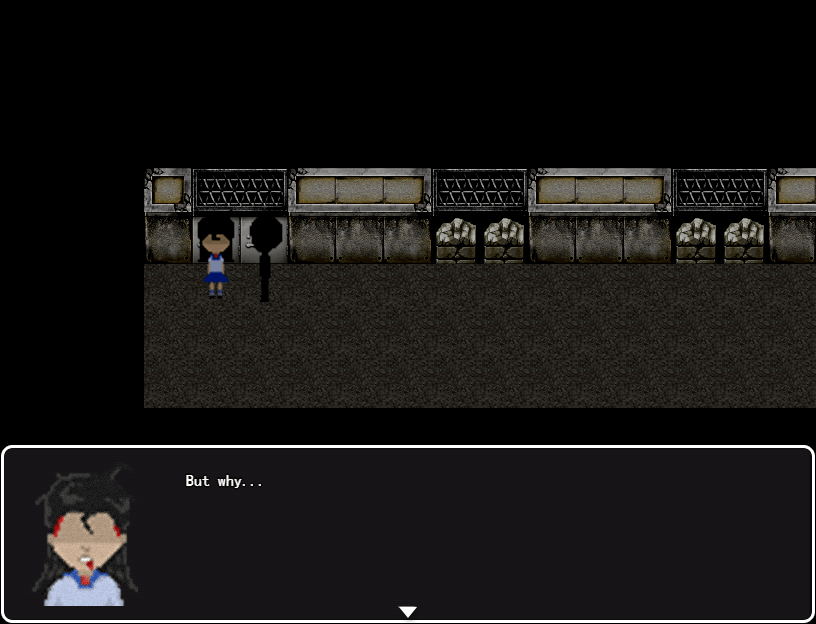
As the designer, scriptwriter and programmer, I spent lots of days on this project. I learnt the basics of RPG maker and was able to create several puzzles, animated event and animated environment on RPG maker. In order to polish the game, I spent hours on integrating tilesets and characters with Photoshop. I also edited several sound effects myself, like the door knocking and doorbell sound effects.
The hardest part of making the game is not having enough time, at first we were planning to make all tiles ourselves, but that means more than 80 pixel arts in the end of semester. Our only artist could not handle this much works. In fact, I do created one pixel art for the tiles. That says, we had to purchased tilesets online so that we can created a similar atmosphere as we wanted.
However, personally the biggest obstacle is the script. I have never been a fan of writing, therefore most of the dialogues are pretty plain and boring in my opinion. But that was the best effort I could make, and I happy about the fact that I still have enthusiasm about games.
Overall, thanks to our artist Chengyuan Shi, he created some very awesome characters and was able to fit the category of puzzle horror game very well. It was really a fun experience, and I think I would complete the game someday if I can find a script writer.
Blog Post 7: JackBox Game
I played BRACKETEERING through ZOOM with my classmates today. Here are my impressions about it.
First, it is somewhat a good looking game which reminds me of some TV shows I used to watch. The UI and sound effects are pretty interesting, and I like them.
Mechanic side, it’s the kind of party game that I would have fun if I can play with my friends and family. But I really can’t find a different situation that I will enjoy it.
Playing with the audience in real life will make the game more enjoyable, but that’s all I guess.
Overall, it provides some good party game choices for me, but I do not think they have any further application.

Blog Post 6: Video Game Prototype
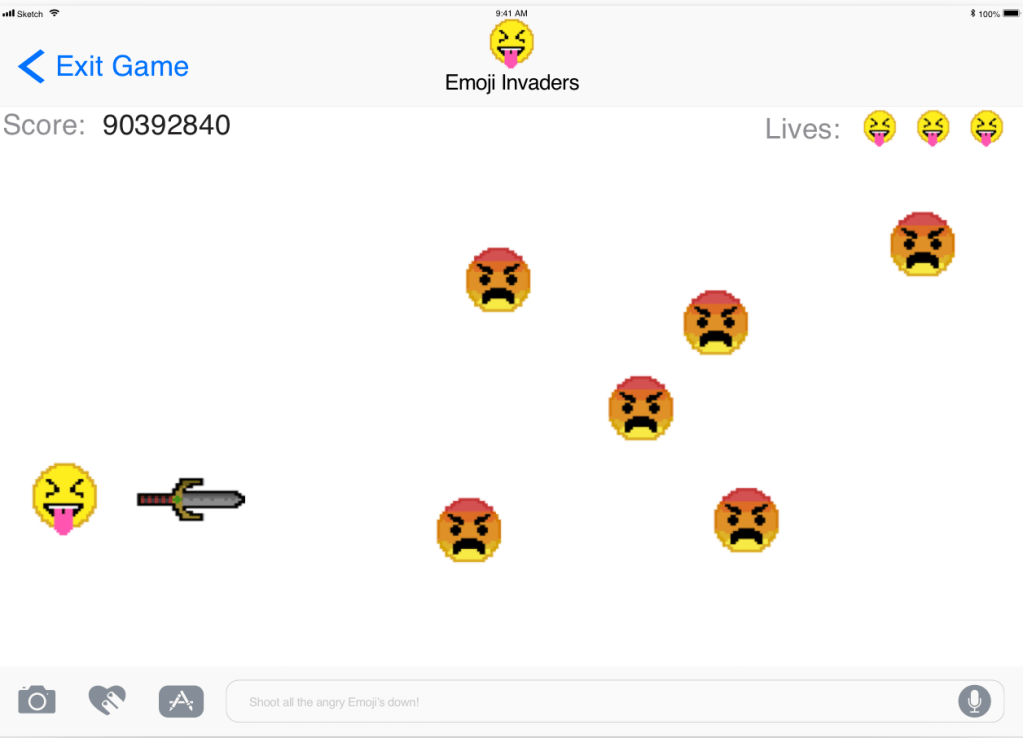
- Title of the game: Emoji Invaders
- Game credits: iOS sound effects, NoCopyrightSounds for the background music
- Instruction: use arrow key or w,s,a,d to move and space to shoot swords
After the alpha test, I studied a lot from the comments of our classmates. Therefore I implemented the progressive difficulty and animated the happy and angry emoji after the alpha test. Besides that, I gave the player 3 health point in every run so it is less frustrating since the difficulty is actually quite hard compare to the alpha. Also, Kenneth corrected some errors in the welcome and instruction scenes. The in-game instruction is much more clear now.
Sadly, I did not have enough time to implement new enemies, stages, and power-up items. Feels like there are more I can do with our game. Working with Kenneth was a great experience. We communicated, worked together and overcome many obstacles we have encounter. One known issue though, Mac with retina screen may not be able to launch the game in 5:4 scale as intended and will cause some UI issues. Other than that everything is good. I am quite proud of the works I have done and willing to work more on game design.
Blog Post 5: First Playable
The name of our game is Emoji Invaders. Kenneth is the artist and designer, and I am the programmer and manager of the game. The concept of the game is to have a happy emoji shooting swords and defends itself from angry emoji swarms. It was a straight forward design pattern, and every feature we implemented in the game was pretty easy to follow. I spent most of my time doing the SHUMP project since that was pretty much what we want the game to be. Unity and C# are very easy to use and modify. The only obstacle we had was making the character animated. The total hour of work I spent on the project is roughly 20 hours, including the time of learning Unity and C sharp.
In both playtest sessions, I observed, the player felt the game was too flat and wished to have some progressive difficulty as the game goes. And they wanted to have some power-up item to make the happy face stronger as the game progresses. I am very positive about these suggestions, and I have already added progressive difficulty in the game. For the power-up item, I am thinking about making the player stronger as the score increase so that the player will be more willing to defeat the angry emojis. Overall, these playtest sessions provided a lot of good feedback and made me feel excited about making the game.
Blog 4: Video Game Lab
So, we were asked to play six video games from a given list in-class on Wednesday. It was quite interesting to do so since it introduced several unique games that I am going to cover lately.
The first game I want to talk about is, “This is the only level.” It implements the idea of how the change of mechanics and dynamics can make the same looking level feel entirely differently. The playthrough relies heavily on the tips that appear at the bottom screen. At this point, this game is more like a puzzle game that guides by tips since some states do not even require the player to do platform jumping, which you can tell the mechanic of the game has already been changed.
Is it a good idea to do so? Not really. People who do not read tips and tutorials (like my partner) will have very little chance to finish all stages since the game is frustrating to continue. It does feel a bit upset for overserving my partner to stop playing the game at stage 8.
It was kind like reviewing my past itchy points coming repeatedly and made me want to laugh. Moreover, it is tough not to telling my buddy the correct way to play through the stage.
The second game I want to talk about is “Dance of fire and ice.” It is a unique rhythm game since it only required one button to play. It is difficult, challenging, and addictive. The design of the stages is very beginner-friendly since the number stages are designed to tell the player the patterns of notations that are going to appear in the x stages. Which is not something done by most rhythm games. It does indeed take away the fun of discovery the correct way to play through every music, but it feels like it is precisely what new rhythm games need.
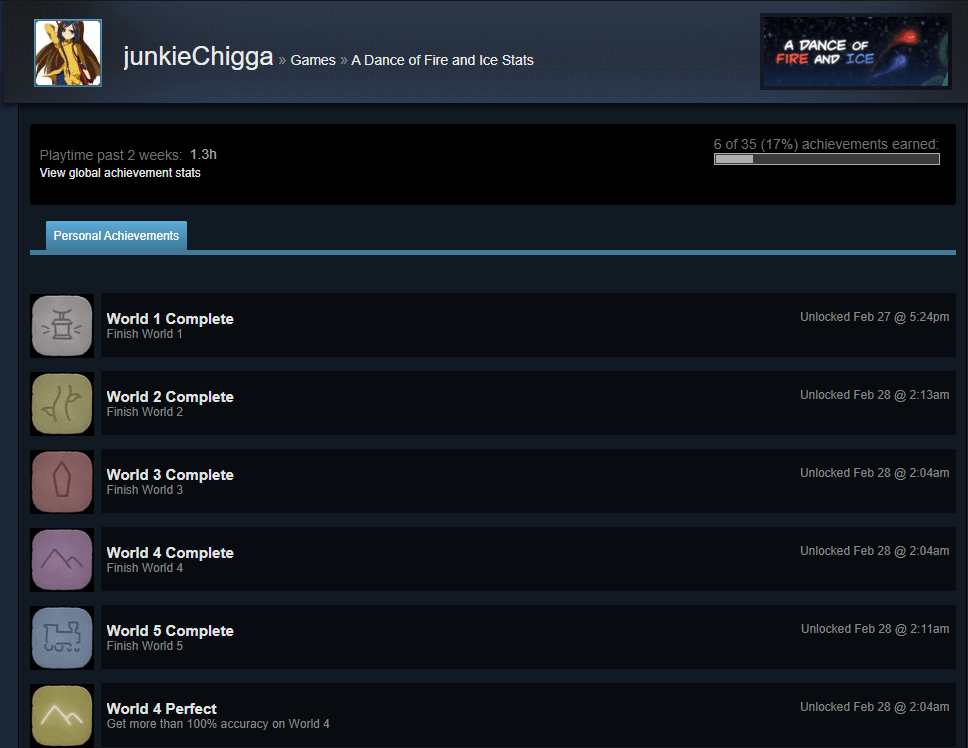
Too many rhythm games have only a straightforward tutorial that only explains the basic controls of the game.
These typical rhythm games will not teach players on reading the levels, which is not so beginner-friendly.
The last two games I want to address are QWOP, and I WANNA BE THE GUY. These two are typical KUSO games, which can be translated from Japanese into shitty games.
They may not be poorly designed games, but simply because they purpose on frustrating the players. They are hard and painful. Their level designs made people feel impossible to finish (though I finished cat Mario and several I WANNA BE games but still). They will only offer you the minimum tutorial to the game, and most of the time, they cannot help you play through the game.
The only way to play through them is to keep trying, keep failing, and keep restarting. It is frustrating but can give the players more “I conquer this game” feelings than other games.
Blog 3: Prototyping
The game I made is named Protect Tokyo, which is inspired by King of Tokyo I played previously and Pacific Rim. It takes place at Tokyo and 2 players are competing each other by controlling 3 battle robots or one gigantic monster. In which the robot side is trying to eliminate the monster or protect Tokyo city for several rounds and the monster side is trying to eliminate all robots or destroy all four grids of Tokyo.
The game has a 6×6 square grids as battleground, 3 robot cards, 1 monster card and few tokens as character models and indicators. It also requires the a set of poker and 2 dice to play.
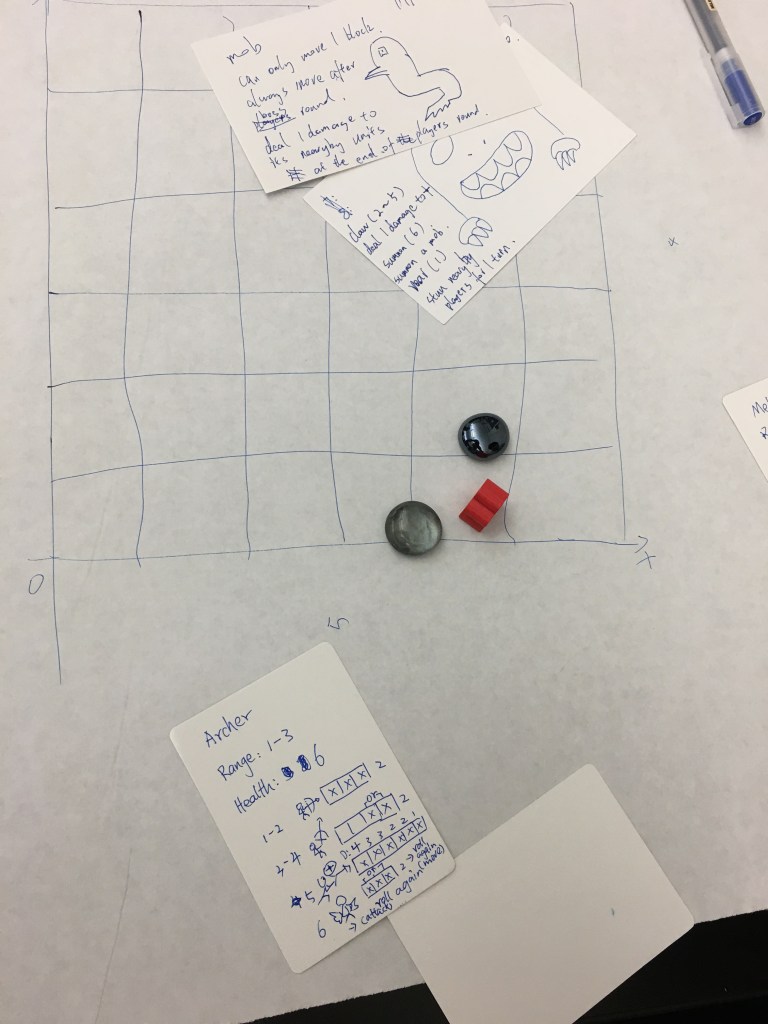
At first, we only have the very basic idea of the game which is going to take place on a 6×6 square grids. And it was thought to be a 2 players co-op and fight a monster with random moves based on dice rolling. In this “prehistoric” version, every move were determined by dice rolling. For example, rolling 1-2 can move 1 grid, 2-4 can move 2 grids and so on. The very first play session was just me and my teammate rolling dices and testing if the grids works well for the game. However, the spawning mechanic was decided during that session-dice rolling. Since we only have a 6×6 grids, it is very easy to think in the way that dice point decides the x-y axis of the spawn grid. After the simple playthrough, we designed several character cards but they were all abandoned in both of our “final version” of the game.
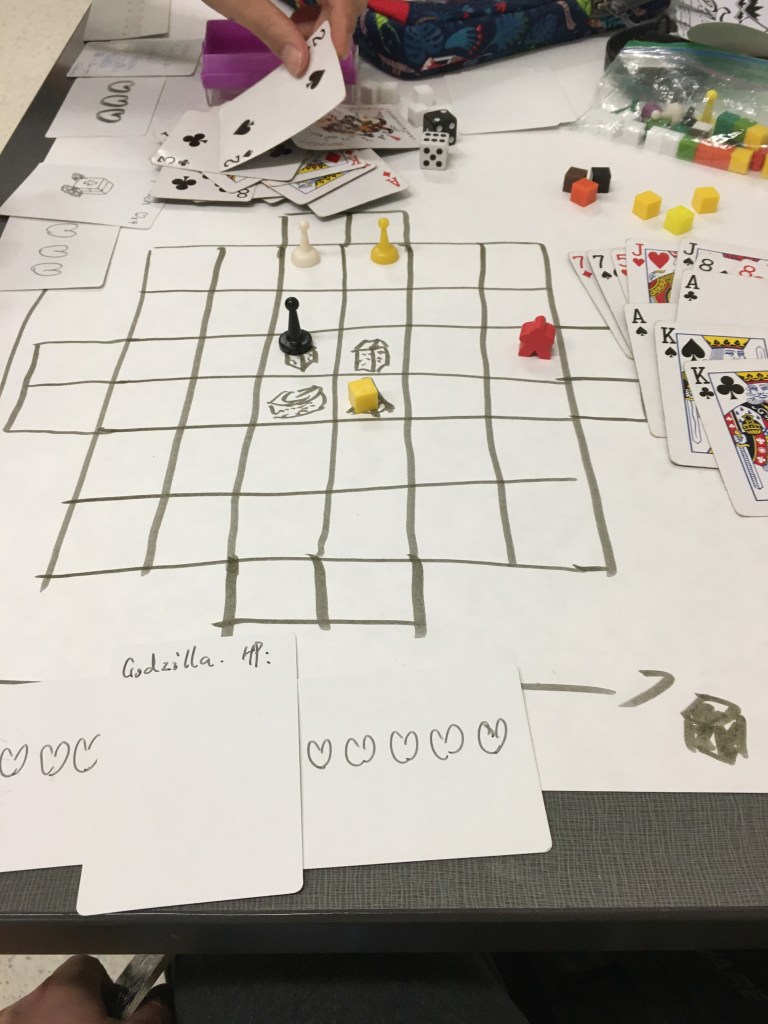
The second play test was between me and my friend, in which I have already decided to shift the game into a 2 players battle arena and core goal is to protect/destroy the Tokyo city. In this version, I abandoned the random move element and let players be able to use their desired abilities by implementing poker hands. In which players will shared one poker deck and trying to run out the other player’s cards. My friend thought it was a good idea but the gameplay was quite buggy. For example, I thought extending 2 grids at the end of the city’s row/column would be a good idea but turns out that monster can easily destroy 2 area of cities by just sitting in the corner since there’s no way to stop the monster from using ultimate skill. Another imbalanced point is that the monster has a skill burrow, which allows it to become invincible, transport in a far grid and deal 1 damage to nearby grids by skipping one round. It turns out that the monster can just spamming this skill and let the other player just sit around. I fixed it by preventing the monster from doing anything after coming out from the underground. Which turns out that the monster would die immediately since the human side have already camped more than 20 cards in the hands. For the first time, the monster was killed. It was so closed to destroy the Tokyo which only one grid left.
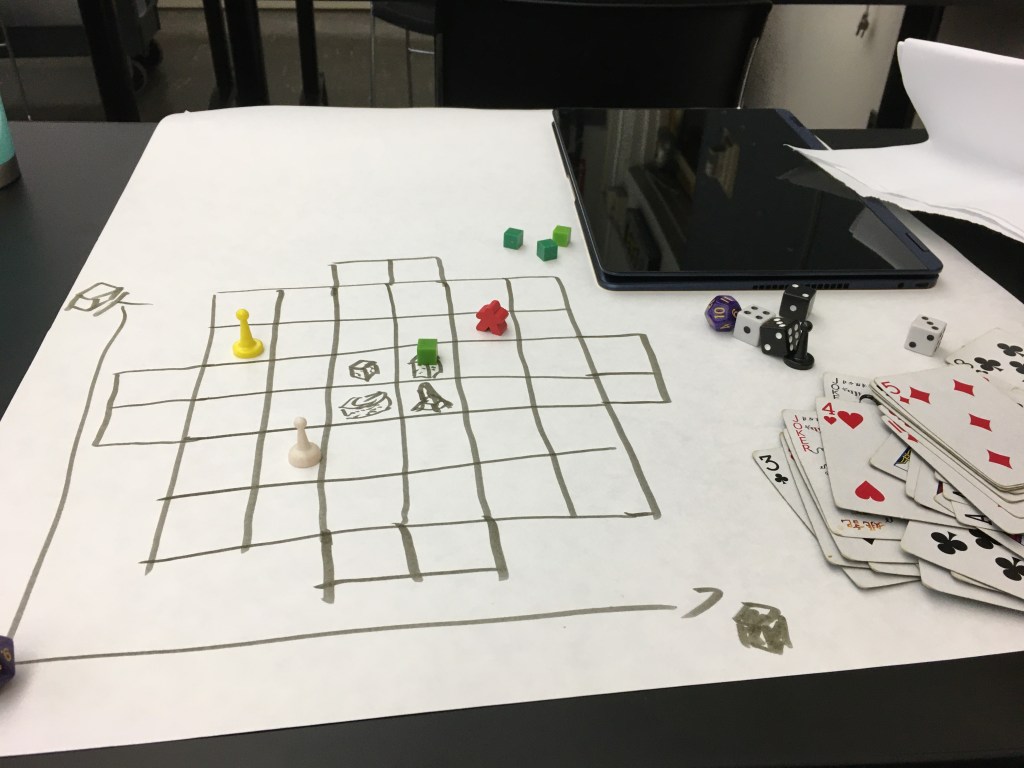
The third play session was done in class, I played it with a classmate. It was quite difficult to explain all these rules to him. But we somehow figured it out. I played as monster and my classmate played as robot pilots. In the first round, I tried to used my ultimate skill on two cities in a column. My class mate decided to punch the monster to the building which destroyed the building that he was supposed to protect and deals an additional damage to the monster. At the end of round 1, the monster fire its blazing fire and destroyed the last city area in that column. And so, the monster was keep being beaten up by the robots and barely won the game with 1 hp by using a burrow.
The core mechanics of this game are square grids, resource movement, grid movement, hand management.
Post 1: Internet Arcade
01/28/2020
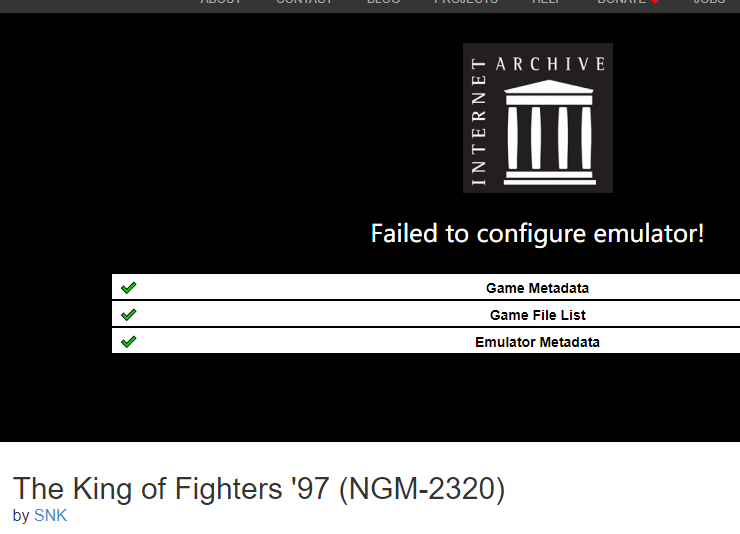
The game I played on Internet Archive is The King of Fighters 97. It is a 2D fighting game developed by SNK and published in 1996. I chose this game because I am very familiar with it since I have been playing this series for more than 15 years. The emulation was clunky and buggy. After 5 minutes playing it, the emulator dysfunction and shows a white screen. I have to reload the web page, and it just stuck at the loading screen forever and ever. (picture 1)
Also, in that short period of experience, I spent most of my time configuring the user input since the default one is entirely unplayable. However, the appearance and sound effects of the emulator is pretty decent. I would give it a five star at these two parts. Other than that, it was a disaster, and I think playing arcade games (particularly games on Neo Geo) on the web is a disaster.
Additionally, emulators will always be emulators, and they will never be able to give us the right feeling of arcade games in terms of the controls, atmosphere, and the pressure of running out of coins. The first reason is that there are so many kinds of controller invented in the past decades. It is tough for a regular user to get the same feeling of playing arcade on the keyboard (even a decent arcade stick for fighting games cost at least 140 bucks).
Author: Jack Zhu
Post 2:Boardgame Lab

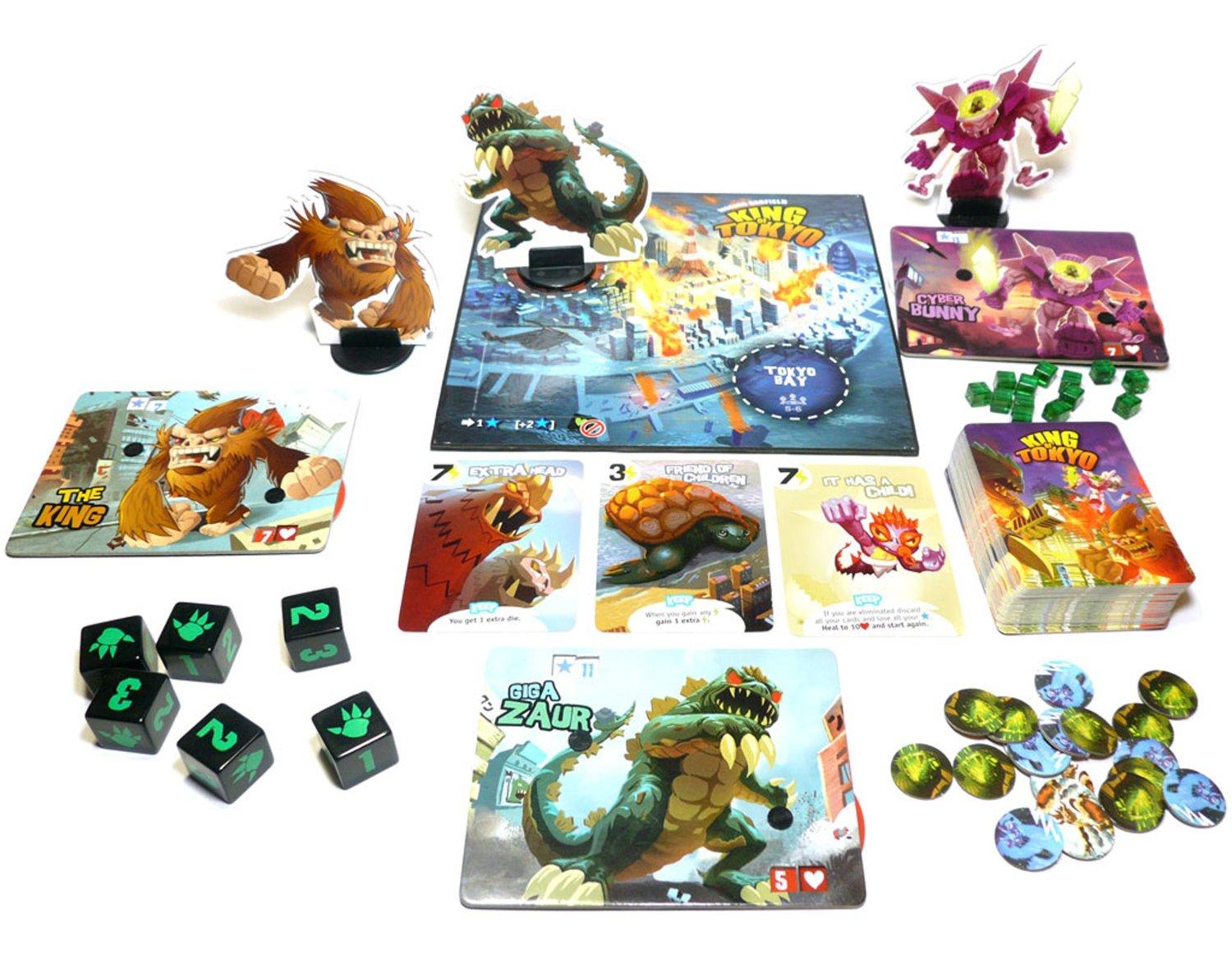
Date: 02/09/2020
Link to King of Tokyo: https://boardgamegeek.com/boardgame/70323/king-tokyo
Introduction
It was everyone’s first time playing King of Tokyo so we spent almost 25 minutes on figuring out how to play the game. Basically it is a game that involves with dice, cards, king of hill, last man standing and some resource strategy. The game takes place in Tokyo city which has a strong Godzilla background that having 2 to 6 monsters fight to death(or 20 victory points). In this game, we have 4 players: Lin, Dan, Sam and myself, Jack.
Before the game started, everyone needs to choose their own monster as their in-game avatar. Different monsters do have their unique skills for advanced gameplay, but we are noob so we decided not to try that.
After the monster selection phase, we have:
Mekadragon (Lin) – 0 VP(victory point) & 10 HP(health point)
The King (Dan) – 0 VP & 10 HP
Kraken (Jack) – 0 VP & 10 HP
Gigazaur (Sam) – 0 VP & 10 HP
Round Plays
Round 1:
Lin is the first one to roll the dice, he only got 2 energy since we are all learning how the dice functions.
Dan is the second one to roll and he rolled two 3’s and rolled nothing till the 3rd roll which gave him 1 energy.
Jack is the third one to roll and he rolled four 3’s and two energy dice resulting in 4 points and 2 energy.
Sam is the last one in the round and he rolled 5 energy, which is enough for him to purchase a card from the shop but he chose to keep it.
Round 2:
Lin rolled several energy point (data lost) and 1 health point. He hasn’t lot any health so the health point is useless.
Dan rolled five 1’s which resulted in 3 victory points.
Jack rolled 2 energy, and another 2 energy which results in four.
Sam rolled dice to collect 1 energy
Round 3:
Lin rolled a claw and has to entered Tokyo since he is the first one rolled a claw. By entering Tokyo, he gained one VP.
Dan rolled four 3’s and attacked the king of Tokyo resulting in him being in Tokyo.
Jack scored 4 points, attacked Dan and collected one energy, which allowed him to purchase a discard card for 5 energy and let all other monsters lose 5 VP. (He thought he could keep it for later use but turns out it need to be used right away)
Sam rolled 3 energy and one claw, and he attacked the monster inside Tokyo and gained 1 VP.
Round 4:
Lin rolled three 3’s and one claw, which result in 4 VP because he attacked the monster inside Tokyo which results in 4 victory points.
Dan just rolled 2 energy.
Jack rolled 2 hearts and 1 energy.
Sam rolled three 1’s and 3 energy dice. Which allowed him to gain 1 point and 3 energy.
Round 5:
Lin stayed in Tokyo so he gained 2 VP. Rolled four 3’s and 2 energy dice, which is 4 points and 2 energy.
Dan rolled 4 VP’s and nothing else.
Jack rolled 4 energy and 2 claws. Lin still chose to stay in the Tokyo and take that 2 damage. Jack purchased a card with 5 energy which gives him 3 VP. He now has 11 VPs.
Sam rolled 1 energy and 3 claws, Lin was about to yield but Sam has a card that will deal 1 damage to the monster yielding in his turn. So Lin chose to stayed.
Round 6:
Lin is still in Tokyo so he gains another 2 victory points. He then rolled 4 energy, and nothing else.
Dan rolled 2 energy and three 2’s, which gives him 2 VPs.
Jack rolled 3’s x 3, 1 claw and 2 energy. Which is 3 points and 2 energy and he attacked Lin who was inside Tokyo. Lin chose to yield.
Sam got 4 points. 3’s x 4, with energy and attack cube. Gained another energy point because of the “energy hoarder card”.
Scoreboard –
Mekadragon (Lin) – 2 health/8 VP
The King (Dan) – 20 health/13 VP
Kraken (Jack) – 5 health/14 VP
Gigazaur (Sam) – 8 health/7 VP
Round 7:
Lin rolled 2 points and 3 hearts
Dan rolled 5 points scored by 3’s x 5 – resulting in 18 VP’s
Jack rolled 2 energy and 1 heart
Sam used card to inflict additional damage and killed kraken who was low on health in Tokyo
Final Round:
Lin used a card to reroll and gained 4 points, but he’s still 6 points away from victory. Dan is going to win unless he roll less than 2 points.
Dan rolled 4 points to win the game which ended up being 22 VP and a full health status.
Summary
To me, the game is actually pretty fun and enjoyable. Even though I am the only one got terminated, it is quite interesting to see how we made there. I will definitely play this game again if I got a chance.
Author: Jack Zhu
 Jack Zhu's blog